
Knights, Castles, and Kindergarteners
Three years ago, our team found themselves in a rich conversation about what kinds of experiences truly nurture young learners. At Concord Hill, we’re always asking: What helps children grow as thinkers? What builds their confidence? What strengthens their social and emotional skills while honoring their natural curiosity?
In those conversations, one idea kept rising to the surface — chess.
Chess may not be the first thing most people associate with five- and six-year-olds, but the more we explored it, the more we saw how beautifully the game aligns with the way young children learn. Chess invites imagination. It rewards persistence. It encourages children to slow down, notice patterns, and think ahead — all habits we want to cultivate early.
To bring chess into Kindergarten in a way that felt right for Concord Hill, we knew we needed a curriculum that aligned with our broader beliefs about how young children learn — through narrative, play, imagination, and movement. When we discovered Storytime Chess, we immediately recognized a philosophy that matched our own. Its character-driven approach offered children a concrete, joyful way to understand a complex game.
Each piece is introduced through a story that explains not just how it moves, but why. In one lesson, the rook becomes a tall castle with bustling hallways stretching straight in every direction. Students meet a character who loves running up and down those hallways — always straight, never diagonal. Later, when they move the rook on the board, they’re not recalling an abstract rule; they’re stepping back into a world they know.
And because young children learn not only with their minds but with their whole bodies, we incorporate “chessercizes” — movement-based activities where students act out the pieces’ motions. They tiptoe like bishops along diagonal paths, march like rooks in straight lines, and hop like knights in big L-shaped leaps. The logic of chess becomes physical, memorable, and fun.
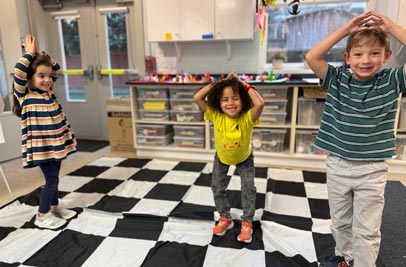
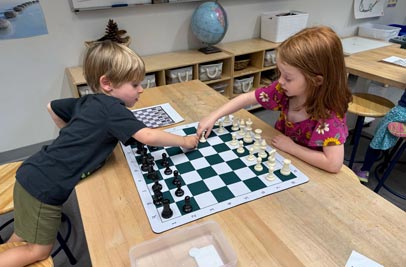
Piece by piece, story by story, and dance move by dance move, chess opens up in ways that feel concrete, lively, and entirely right for their developmental stage.
As the year unfolds, chess becomes a powerful space for social-emotional learning. Children experience the full range of emotions that comes with playing a game — excitement, frustration, pride, and disappointment. We help them notice those feelings and handle them with care. And at the end of each match, we have a steady routine: we shake hands, even when we lose. It’s a simple practice that reinforces empathy, resilience, and the understanding that how we treat each other matters just as much as the moves on the board.
Our chess class is co-taught by Stephanie Folarin, Associate Head of School, and Danon Walton, our STEM Teacher. Together, they create a classroom environment where students feel supported, curious, and ready to explore.
Now in its third year, the chess program has become a cherished part of our Kindergarten experience. We’ve watched students grow more confident in their thinking, more flexible in their problem-solving, and more connected to their peers.When we see them leaning over their boards, whispering the stories that help them remember each piece, or joyfully leaping across the room in a knight’s hop, it’s clear that chess has become more than a game. It has become a way to think, a way to move, a way to feel — a joyful pathway into understanding themselves as capable, creative, connected learners.